Step on a scale in the US and you get a number in pounds. Every BMI chart you've ever seen, though, was built on kilograms and meters. That mismatch is exactly why "imperial BMI calculator" is one of the most-searched versions of this question — most people just want the pounds-and-inches math, not a metric conversion first.
So here it is, in imperial units, right away: `BMI = [weight in pounds ÷ (height in inches × height in inches)] × 703`. Weigh 165 lbs at 5'11" (71 inches)? [165 ÷ (71 × 71)] × 703 = 23.01. That puts you in the "normal weight" band on the CDC's adult chart (see categories below).
Prefer to skip the arithmetic? Our free BMI calculator takes pounds and inches (or kg and cm) directly and gives you the number instantly — same formula the CDC and WHO use, just without the mental math.
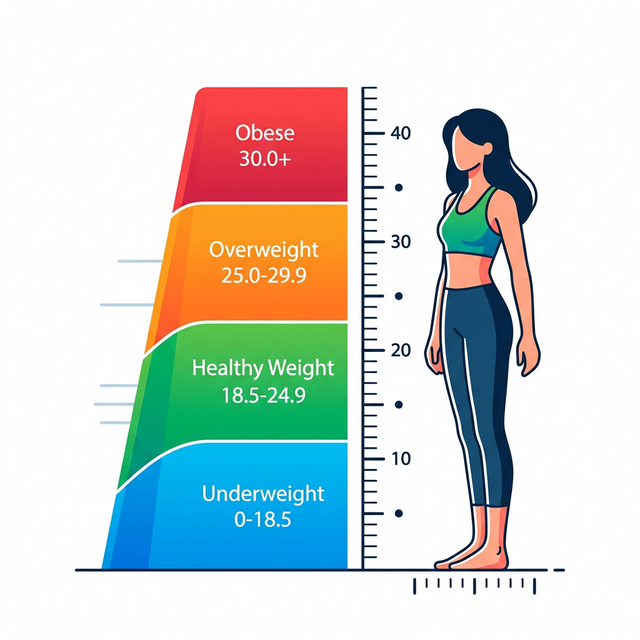
The imperial formula, and why 703 shows up
The "true" BMI formula is metric — weight in kilograms divided by height in meters, squared. The CDC is explicit that BMI is a screening measure, "not intended to diagnose disease or illness" (CDC.gov, accessed 2026). It flags who might need a closer look, not who's sick.
Imperial units (pounds & inches):
* Formula: `BMI = [Weight (lbs) ÷ (Height (in) × Height (in))] × 703`
* Example: 165 lbs at 71 inches → [165 ÷ (71 × 71)] × 703 = 23.01
Metric units (kilograms & meters):
* Formula: `BMI = Weight (kg) ÷ [Height (m) × Height (m)]`
* Example: 75 kg at 1.8 m → 75 ÷ (1.8 × 1.8) = 23.15
That 703 isn't arbitrary — it's the conversion factor that rescales pounds-and-inches onto the same curve as kilograms-and-meters. Run both examples above and you land in the same range either way.
Quick reference: pounds by height and BMI category
Don't want to run the formula at all? Find your height, then see roughly where your weight lands. Each number below is the weight (in pounds) that sits right on the category boundary — the CDC categories from the section below applied to that height:
| Height | Underweight below | Normal 18.5–24.9 | Overweight 25–29.9 | Obese at/above |
|---|---|---|---|---|
| 5'0" | 95 lbs | 95–127 lbs | 128–153 lbs | 154 lbs |
| 5'2" | 101 lbs | 101–136 lbs | 137–163 lbs | 164 lbs |
| 5'4" | 108 lbs | 108–145 lbs | 146–174 lbs | 175 lbs |
| 5'6" | 115 lbs | 115–154 lbs | 155–185 lbs | 186 lbs |
| 5'8" | 122 lbs | 122–163 lbs | 164–196 lbs | 197 lbs |
| 5'10" | 129 lbs | 129–173 lbs | 174–208 lbs | 209 lbs |
| 6'0" | 136 lbs | 136–183 lbs | 184–220 lbs | 221 lbs |
| 6'2" | 144 lbs | 144–194 lbs | 195–233 lbs | 234 lbs |
These are computed straight from the imperial formula above, not a separate lookup table — use the BMI Calculator if your height falls between rows or you want an exact figure.
Understanding adult BMI categories
For adults 20 and older, the CDC defines four official weight categories (CDC.gov, accessed 2026), and the same brackets apply "regardless of age, sex, or race" — which is also how the table above was derived: same four thresholds, run through the imperial formula for each height.
Underweight (BMI under 18.5)
May mean compromised immunity, bone density issues like osteoporosis, or anemia. Often a downstream sign of something else — a thyroid disorder, an eating disorder — rather than a standalone problem. Talk to a doctor or registered dietitian about safe weight-gain strategies if you land here.
Normal / healthy weight (18.5 to just under 25)
Lowest statistical risk for weight-related chronic illness — heart disease, type 2 diabetes. A balanced diet (our Calorie Calculator finds your daily target) and regular movement maintain it. But it's a statistical band, not a guarantee: a sedentary person at 23 can have poor cardiovascular fitness, while an active person at the top of the range can be metabolically excellent.
Overweight (25 to just under 30)
Elevated risk for high blood pressure, cholesterol issues, and cardiovascular disease — but you don't need a "perfect" BMI to see benefit. The CDC notes that even modest weight loss can "improve your blood pressure, cholesterol, and blood sugar levels" (CDC.gov, accessed 2026). A 5% reduction for someone at 200 pounds is just 10 pounds — enough to move the needle on heart disease, prediabetes, and type 2 diabetes risk.
Obesity (30.0 and above)
Linked to stroke, clinical depression, osteoarthritis, and sleep apnea. The CDC breaks this further into three classes so doctors can gauge severity:
* Class 1: 30 to under 35
* Class 2: 35 to under 40
* Class 3 (severe): 40 and above
Class 3 is generally the threshold where physicians start discussing more intensive medical interventions.
Is BMI actually accurate? (The limitations)
BMI earns its place as a population-level screening tool because it's cheap, fast, and non-invasive. On an individual level, though, it's a blunter instrument than most people assume. The CDC itself says BMI "does not distinguish between fat, muscle, and bone mass" (CDC.gov, accessed 2026).
That gap shows up fastest with muscle. Because muscle is denser and heavier than fat, trained athletes, bodybuilders, and heavy lifters often land as "overweight" or "obese" on the chart despite single-digit body fat and excellent cardiovascular health. A 6-foot, 230-pound linebacker and a 6-foot, 230-pound couch potato share the exact same BMI of 31.2 — and nothing else. If you lift regularly and want a number that actually reflects your composition, a Body Fat Calculator fills in what BMI can't see.
It fails in the other direction for older adults, too. Someone who's lost muscle mass to aging (sarcopenia) can register a "healthy" BMI while carrying a dangerous amount of visceral belly fat. BMI also reads differently across populations because body composition and frame size vary — one more reason clinicians treat it as a starting point, not a verdict.
Why waist circumference matters
Pair your BMI with your waist circumference for a fuller metabolic picture. Measuring just above your hip bones reveals visceral fat — the kind that wraps around internal organs. The National Heart, Lung, and Blood Institute (NHLBI, accessed 2026) flags elevated risk for type 2 diabetes and heart disease at a waist measurement of more than 35 inches for women or more than 40 inches for men. A normal BMI with a large waist measurement can surface a risk that BMI alone would have missed entirely.
Some people go a step further and add a waist-to-height ratio. We don't have a CDC/NHLBI figure for this one specifically — it's an editorial rule of thumb we've seen used in clinical practice: keep your waist under half your height. Combine two or three of these and you get a far more honest read than any single number offers.
Frequently asked questions
How do I calculate BMI in pounds and inches without a calculator?
Use [weight in lbs ÷ (height in inches)²] × 703. At 165 lbs and 71 inches, that's [165 ÷ 5,041] × 703 = 23.01.
How often should I check my BMI?
There's no CDC-mandated schedule here. Our own rule of thumb: once every 6 to 12 months is enough for most adults, since your height's fixed and your weight should stay fairly stable unless you're actively changing it.
What is a healthy BMI for a woman over 50?
The official CDC categories don't change by age, sex, or race — the healthy range is 18.5 to under 25 for every adult 20 and up. Whether to target the higher or lower end of that range as you age is a judgment call best made with your own physician, not something BMI alone can answer.
Is BMI calculated the same way for men and women?
Yes. For adults 20 and over, the formula and category brackets are identical regardless of gender. (Kids and teens use age- and sex-specific percentile charts instead of these fixed numbers.)
Does BMI apply to pregnant women or athletes?
Not reliably. It isn't designed for pregnancy, and as covered above, it can badly misclassify muscular athletes. For both groups, treat the number as one input among several — not the answer — and lean on a clinician's assessment.
Take control of your health
Knowing your BMI is step one. Step two is doing something with it — not just chasing a number on a chart.
Run your numbers now with our free **BMI Calculator (it takes pounds/inches or kg/cm — your call). If losing weight is the goal, the Calorie Calculator** shows exactly how much energy your body needs to burn fat while holding onto muscle.
This article is for general educational purposes only and is not medical advice. BMI is a screening tool, not a diagnosis. Always consult a qualified healthcare provider before making decisions about your weight, diet, or health.